Laser Technology Innovations at COLA 2026: From Fundamental Physics to Interdisciplinary Applications


From 14 to 18 September 2026, Vilnius hosted COLA 2026, the international conference on laser ablation, bringing together the global laser science and technology community. Over the course of five days, the event showcased the latest research, ranging from fundamental studies of laser–matter interactions to innovative solutions for the semiconductor industry, biomedicine, and advanced manufacturing.
The conference programme demonstrated that modern laser technologies are rapidly moving beyond the boundaries of conventional materials processing. Lasers are becoming increasingly precise tools, while their integration with artificial intelligence (AI) and digital technologies is opening up new opportunities for practical applications.
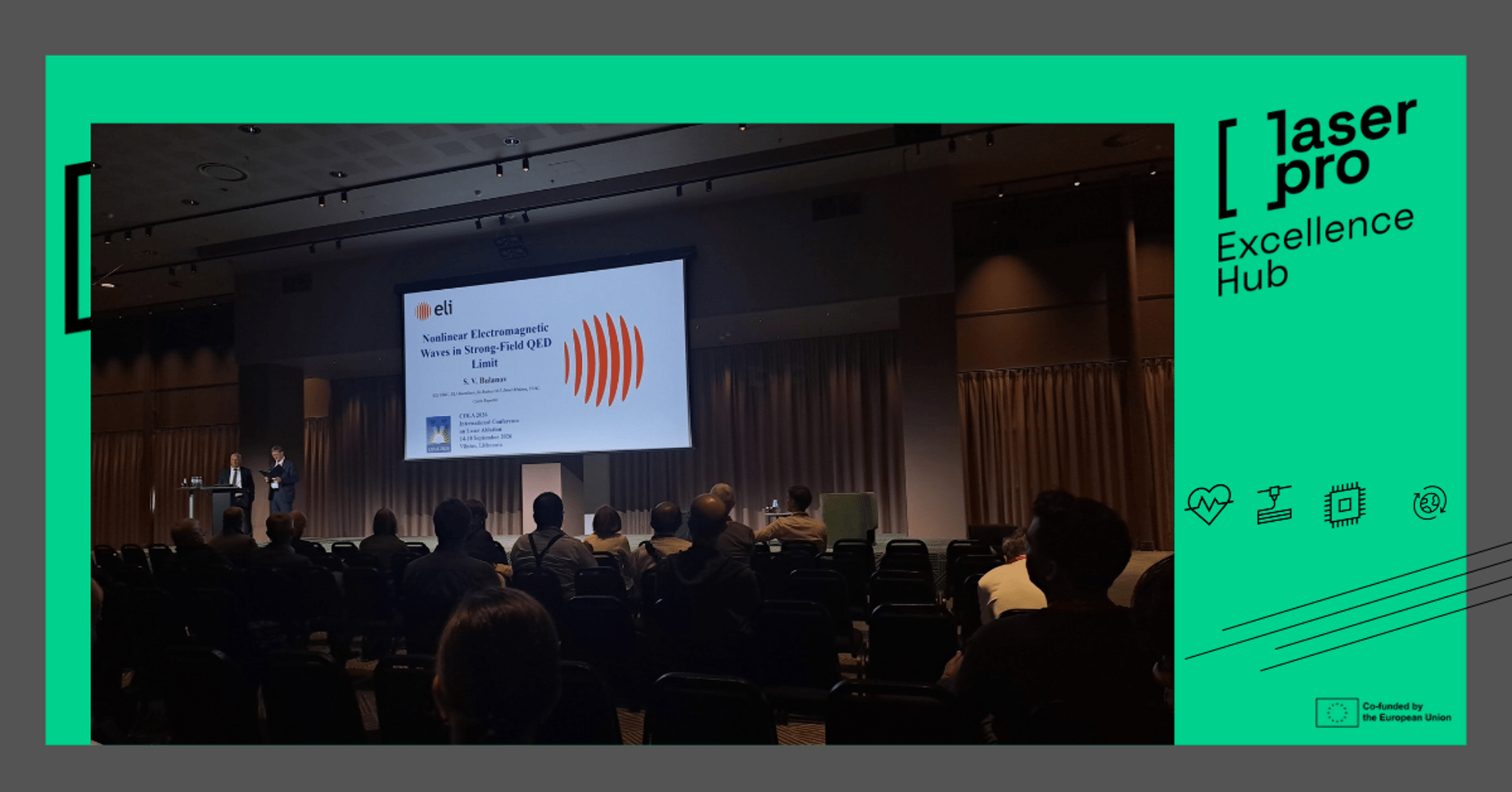
The conference's plenary programme highlighted the importance of fundamental laser physics. Prof. Sergei Bulanov, a researcher representing ELI Beamlines, an international high-power laser research infrastructure in the Czech Republic, delivered a presentation entitled “Nonlinear Electromagnetic Waves in Strong-Field QED Limit” His presentation explored nonlinear electromagnetic waves and their interaction with strong-field quantum electrodynamics, highlighting the scope of fundamental laser physics research and its relevance to the development of next-generation, ultra-high-intensity laser technologies.
Semiconductors: Opportunities for Precision Processing
One of the key topics at COLA 2026 was the application of lasers in semiconductor technologies. The conference featured a method for separating silicon carbide (SiC) wafers with low kerf losses, based on a two-step femtosecond laser modification strategy. Other presentations addressed indium phosphide (InP) processing and the fabrication of through-silicon vias (TSVs).
In modern electronics, the properties of materials are only part of the equation; the ability to process them with extremely high precision is becoming increasingly important. Laser radiation enables highly localized energy delivery and the fabrication of complex structures required for next-generation electronic components.
The potential of precise laser beam control was also explored by Dr. Juozas Dudutis, a researcher at the Center for Physical Sciences and Technology (FTMC), who presented a method for generating non-diffracting laser beams with different longitudinal and transverse intensity profiles.
“Precise control of the laser beam intensity distribution is particularly important for the volumetric processing of materials, for example, for structuring, drilling, and cutting glass or other substrates. Tailored beams could enable more precise control of energy deposition within a material, help avoid unwanted damage, reduce the number of processing steps, and accelerate processing,”- says Dr.Juozas Dudutis.
The method he presented uses laser amplitude filters to generate different beam intensity profiles, ranging from flat-top and sinusoidal profiles to rising and falling distributions. According to Dr J. Dudutis, one of the advantages of the method is its simpler optical system and the potential to manufacture the elements faster and at lower cost than some alternative solutions, such as spatial light modulators or diffractive optical elements.
Such approaches are particularly relevant to the volumetric processing of challenging materials, including semiconductors. According to Dr J.Dudutis, combining spatial and temporal laser beam shaping could pave the way for new methods to process such materials more efficiently, including cutting, drilling, and welding, as well as for fabricating waveguides, diffraction gratings, and other photonic elements.
Biomedicine: Lasers for Micro- and Nanostructuring
The use of lasers in medicine and biology is also expanding rapidly. A dedicated session at COLA 2026 featured femtosecond laser-based 3D bioprinting technologies, methods for isolating rare cells, and hybrid 3D printing approaches for bone tissue engineering.
Another group of presentations explored laser-based protein printing and Direct Laser Writing (DLW). These studies demonstrate how lasers are becoming increasingly precise tools for controlling material structures at the micro- and nanoscale and for developing new solutions in biomedicine.
Sustainable Manufacturing and Digitalisation: Precision and Efficiency
Another important theme at COLA 2026 was the potential of laser technologies to transform manufacturing processes. Ultrashort laser pulses enable highly precise energy delivery to materials, making it possible to control surface modification, microstructuring, cutting, and drilling.
For industry, this level of precision means not only the ability to manufacture more complex components, but also greater control over the production process itself. More precise process control can help reduce unwanted material damage, minimise the risk of defects, and eliminate unnecessary processing steps. This is particularly important for manufacturing high-value components subject to stringent precision and quality requirements.
At the same time, the digitalisation of laser technologies makes it possible to monitor and optimise manufacturing processes based on real-time data. COLA 2026 placed considerable emphasis on the use of artificial intelligence and machine learning, with methods presented for optimising laser ablation efficiency, modelling surface structures, and predicting potential defects.
Such solutions can help industry move from predefined manufacturing parameters towards more flexible, data-driven processes. In practical terms, this means greater control over product quality, faster identification of process deviations, and more efficient use of materials and production resources.
The combination of laser and digital technologies is therefore important not only for improving technological precision. It also creates opportunities to develop more efficient, flexible, and resource-efficient manufacturing processes – an increasingly important factor in industrial competitiveness.
From the Laboratory to Practical Applications
COLA 2026 demonstrated that advances in laser technologies are taking place across multiple interconnected fields. Fundamental research into laser–matter interactions is becoming increasingly closely linked to semiconductor technologies, photonics, biomedicine, advanced manufacturing, and digital solutions.
At the same time, the path from laboratory research to real-world technological applications is becoming increasingly important. The laser beam shaping method presented by Dr. Juozas Dudutis at the conference has currently reached Technology Readiness Level 4 (TRL 4). Following his presentation, the researcher attracted interest from both the scientific and industrial communities and discussed potential avenues for collaboration addressing specific materials processing challenges.
“In the near future, we will apply structured beams to materials processing. We hope that the results achieved will contribute to the further development of the technology and accelerate its adoption,”- says Dr. Juozas Dudutis.
Dr. Juozas Dudutis is a researcher at FTMC and a member of the LASER-PRO project team. The laser beam shaping method he is developing is being applied within one of the project's activities. Together with HiLASE and other project partners, this work contributes to the development of an innovative photonic integrated circuit array.
The international LASER-PRO project brings together partners from Lithuania, the Czech Republic, and Ukraine and focuses on advancing laser technologies in the fields of sustainable manufacturing, semiconductor technologies, biomedicine, and digital laser-based solutions.