


3D Printing in Laser Engineering: From Prototype to Functional Thermal Management Components
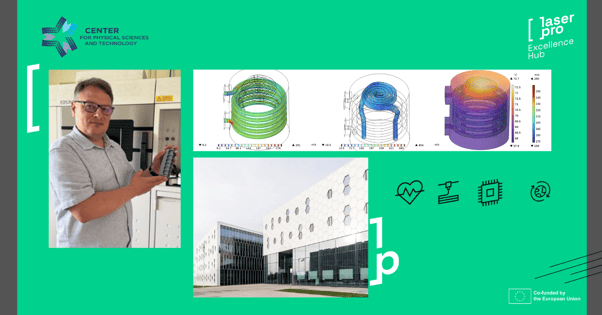
For many people, 3D printing is still primarily associated with the rapid production of plastic prototypes. However, in advanced engineering, this technology has long evolved beyond prototyping. Today, it enables the fabrication of functional metal components with geometries, internal structures, and thermal characteristics that would be difficult—or even impossible—to achieve using conventional manufacturing methods.
This is precisely the direction pursued in the LASER-PRO project, where the Center for Physical Sciences and Technology (FTMC), together with HiLASE and CARDAM, is developing 3D-printed thermal management components for advanced laser systems.
Why Do Laser Systems Need a New Generation of Components?
In high-power, compact laser systems, thermal management is a critical factor determining operational reliability. Even a slight localized increase in temperature can cause component deformation, alter the alignment of optical elements, and compromise the stability of the optical system.
3D printing enables components to be designed from the inside out, incorporating integrated spiral, branching, or multi-channel cooling pathways. This allows the coolant to be directed precisely to regions experiencing the highest thermal loads, while making complex internal geometries—previously difficult or impossible to manufacture using conventional techniques—practical to produce.
FTMC Role in the LASER-PRO Project
Within the LASER-PRO project, FTMC's Laboratory of 3D Technologies and Robotics serves as an advanced platform for additive manufacturing, prototyping, and experimental validation. The laboratory integrates state-of-the-art CAD design tools, digital modelling and multiphysics simulation platforms, the EOS M280 metal additive manufacturing system, and comprehensive equipment for the characterization and analysis of manufactured components.
This integrated technological workflow enables the rapid transition from concept to functional metal prototype. As part of the LASER-PRO project, the FTMC team is developing a range of 3D-printed thermal management components for laser systems, including cooling plates, laser beam absorbers, air-cooled heat management elements, and housings with integrated cooling channels.
The capabilities of the FTMC laboratory are well demonstrated by a previously developed air-cooled metal mirror designed for high-power laser applications. This achievement highlights that 3D printing is not only a tool for rapid prototyping but also a viable manufacturing technology for functional laser components, where internal geometry, thermal management, and mechanical stability are engineered as an integrated system.
Practical Benefits for the Laser Industry
The solutions being developed within the LASER-PRO project have the potential to enable more compact, stable, and reliable laser systems. Improved thermal management translates into reduced thermal deformation, enhanced optical alignment stability, and greater long-term operational reliability.
The impact of these technologies extends well beyond the laser industry. 3D-printed thermal management components can also be applied in semiconductor manufacturing equipment, space technologies, electronics cooling, defence systems, medical devices, and other high-value engineering applications where efficient heat dissipation within confined spaces is essential.
What Comes Next?
By the end of the LASER-PRO project, the consortium aims to design, manufacture, and experimentally validate next-generation 3D-printed thermal management demonstrators for advanced laser systems. The objective is not only to demonstrate that such components can be successfully manufactured, but also to verify that they deliver measurable improvements in the thermal and mechanical stability of laser systems under real operating conditions.
Looking ahead, 3D printing in laser engineering will become more than a manufacturing technology—it will represent a new design paradigm. Instead of designing components according to the limitations of conventional machining processes, engineers will be able to optimise them based on how heat should be dissipated, how coolant should flow, and how the entire optical system can maintain maximum stability.
In laser engineering, 3D printing enables designers to engineer not only the external shape of a component, but also its internal functionality—integrating thermal management, coolant flow, and mechanical stability into a single, optimised architecture.


